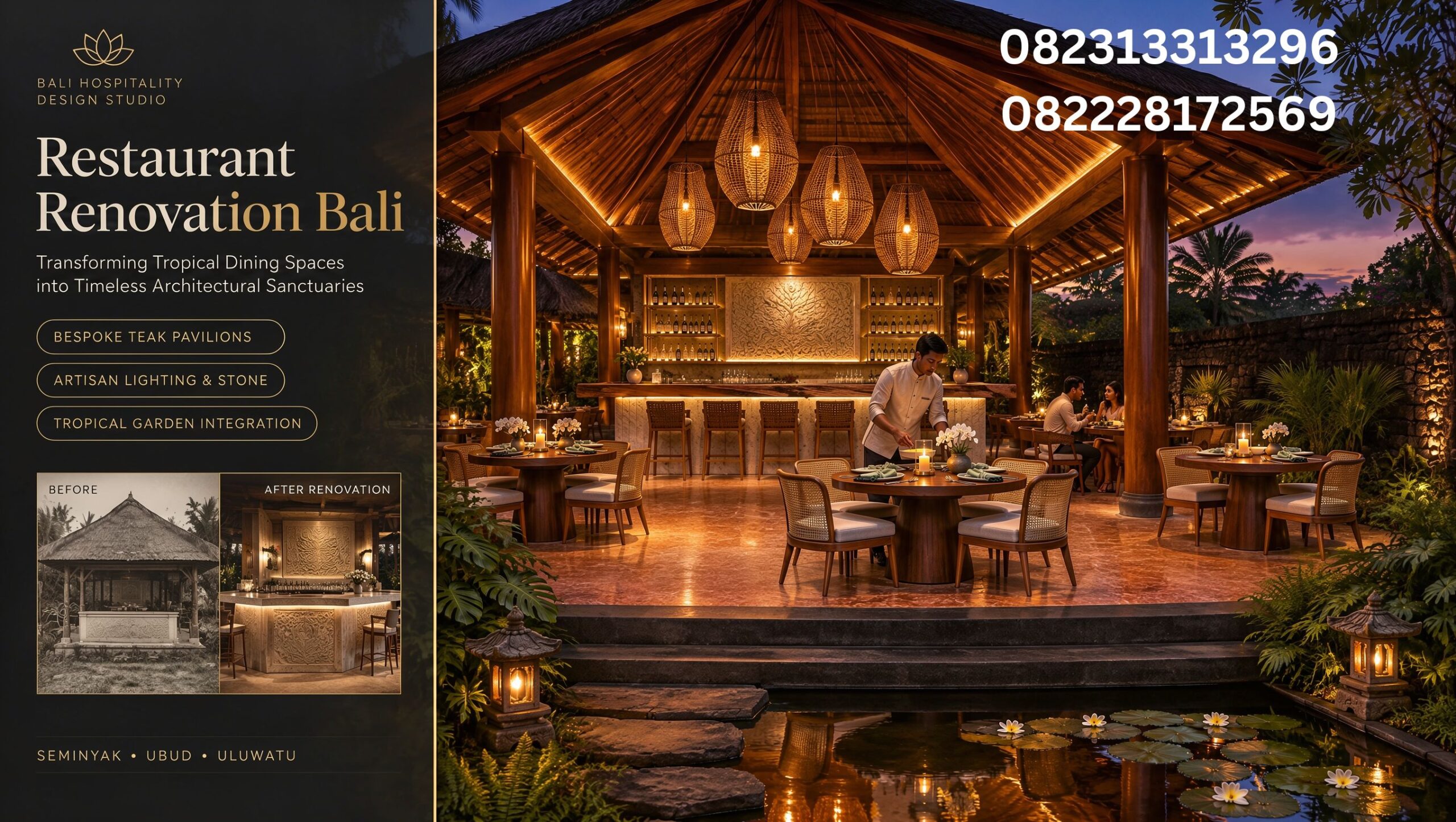
Restaurant Renovation Bali: What Owners Get Wrong and How to Fix It Before You Build – arovabuild
Restaurant Renovation Bali – The most expensive mistake in a restaurant renovation in Bali usually happens before anyone picks up a hammer. Owners fall in love with a look they saw on social media, hire someone to copy it, and then find out within one rainy season that the materials can’t handle the island. Veneer peels, metal rusts near the beach, timber swells, and the kitchen exhaust drips grease onto the dining floor because the ducting was an afterthought.
After years of working on commercial interiors, I can tell you this pattern repeats more than any other. The fix isn’t spending more money. It’s spending it in the right order, on the right things, with a team that understands how Bali’s climate, regulations, and guest expectations shape every decision.
This guide follows a simple path. First, we look at the problems that hit Bali restaurant renovations most often. Next, we trace those problems to their real causes. After that, we cover practical solutions, and finally, how to choose the right renovation approach and partner for your space.

Chat on WhatsApp
Chat on WhatsApp
The Problems That Show Up Six Months After Opening Day
Many renovation issues stay hidden at the launch party. They appear later, once humidity, heavy foot traffic, and daily cleaning start working on your finishes.
Finishes That Look Great in Photos but Fail in Humidity
Restaurant Renovation Bali – Bali sits around 70 to 90 percent relative humidity for much of the year. During the wet season, roughly November to March, the air stays damp for weeks. Interior-grade MDF, cheap laminates, and untreated softwoods absorb that moisture and start to bubble, warp, or grow mold behind panels.
For a restaurant, this means more than a cosmetic headache. Mold near food prep areas becomes a hygiene problem, and a swollen bar top becomes a daily irritation for your staff.
Coastal Corrosion in Canggu, Seminyak, Jimbaran, and Uluwatu
Restaurant Renovation Bali – If your restaurant sits within a few kilometers of the ocean, salt air will attack mild steel, low-grade stainless, and standard hardware. Hinges seize up, light fixtures stain, and outdoor furniture frames bubble under the paint. As a result, owners end up replacing items within two years that should have lasted ten.
Kitchens That Can’t Keep Up With Service
Here’s a quiet killer. A dining room gets a beautiful makeover, but the kitchen layout stays the same, or worse, gets squeezed to make room for more seats. Then the ticket times climb, staff bump into each other, and reviews start mentioning slow service rather than the gorgeous new interior.
Renovations That Drag Into Peak Season
Bali’s busiest months, typically July to August and late December to early January, are when you need every table open. A renovation that runs late into those windows can cost more in lost revenue than the project itself. Delays caused by material shortages, rain, or poor coordination are common, and they hurt.
Why These Problems Keep Happening
Restaurant Renovation Bali – Understanding the cause makes the solution obvious. Most renovation failures in Bali trace back to four roots.
Designing for appearance first. A mood board is a starting point, not a specification. Without translating that look into climate-suited materials, you’re building a set, not a restaurant.
Treating the kitchen as a separate project. In reality, the kitchen, exhaust, drainage, electrical load, and gas lines drive everything. If they’re planned last, the front of house has to work around compromises.
Underestimating logistics. Bali imports a large share of its building materials and furniture from Java. Specialty items, custom joinery, and certain fittings travel overland and cross the Bali Strait by ferry from Ketapang to Gilimanuk. That route works well, but it needs planning. On top of that, Nyepi, the Balinese Day of Silence, shuts down the island completely for 24 hours, including the airport and roads. Ceremony days in your local banjar can also affect when noisy work can happen.
Skipping the permit conversation. Commercial renovations that touch structure, facade, or building function may require building approval updates under Indonesian regulations (such as the PBG and SLF framework). Requirements vary by scope and regency, so the right move is to check early rather than discover a problem mid-build.

Practical Solutions for a Restaurant Renovation in Bali That Lasts
Now for the useful part. These are the approaches that consistently produce restaurants that still look sharp three years later.
Start With an Operational Walkthrough, Not a Mood Board
Before talking about colors, map how your restaurant actually works. Where do deliveries arrive? How do dirty plates travel back to the dish station? Where does a server stand during a rush? How many covers do you need on a full night?
Once that flow is clear, design can follow it. A good renovation team will sit with your head chef and floor manager, not just the owner, because those people know where the bottlenecks hide.
read also : https://arovabuild
Choose Materials for the Microclimate You’re Actually In
Ubud’s inland humidity behaves differently from Uluwatu’s salty clifftop wind. Sanur’s beachfront differs from a shophouse unit in Denpasar. Because of that, material choices should match your exact location.
Here’s a practical comparison of common options for Bali restaurant interiors:
| Material | Best Use | Strengths | Watch Out For |
|---|---|---|---|
| Kiln-dried teak | Tables, bar tops, outdoor furniture | Natural oils resist moisture and insects; ages well | Higher cost; needs proper drying and finishing |
| Marine plywood with HPL | Cabinets, wall panels, back-of-house | Stable in humidity, easy to clean | Edges must be sealed fully or moisture creeps in |
| Standard MDF | Dry, air-conditioned interiors only | Affordable, smooth finish | Swells quickly if exposed to damp or spills |
| Stainless steel grade 316 | Coastal hardware, outdoor fixtures, kitchen | Strong salt resistance | More expensive than grade 304 |
| Stainless steel grade 304 | Indoor kitchens away from the coast | Good hygiene, cost-effective | Can tea-stain in salty air |
| Powder-coated aluminum | Outdoor frames, window systems | Lightweight, won’t rust | Coating quality varies; scratches need touch-up |
| Terrazzo or porcelain tile | High-traffic floors | Durable, easy to mop, slip-resistant options | Grout lines need sealing in wet areas |
| Natural stone (paras, andesite) | Feature walls, outdoor areas | Strong local character | Porous; requires sealing and maintenance |
The pattern here is simple. Spend on the surfaces guests touch and the areas exposed to water or salt. Save on decorative elements that stay dry and out of reach.

Plan the Kitchen and MEP First
MEP means mechanical, electrical, and plumbing. In a restaurant, this covers exhaust hoods, grease traps, gas lines, cold storage power, and drainage. Get these right first, and the dining room becomes much easier to design.
A few practical tips from projects that went smoothly:
- Size the exhaust system for your actual menu. A grill-heavy concept needs far more extraction than a café serving pastries.
- Install a proper grease trap that’s accessible for cleaning. A hidden trap that nobody can reach becomes a blocked drain during your busiest week.
- Check electrical capacity before adding new equipment. Many older Bali buildings struggle with the load from multiple fridges, ovens, and air conditioning.
- Slope floors toward drains in wet areas, and use coved skirting so water and dirt don’t collect in corners.
Phase the Work Around Your Revenue
If you’re renovating an operating restaurant, you rarely need to close for the whole project. Instead, consider splitting the work into phases. For example, you could renovate the outdoor terrace while the indoor room keeps serving, then switch. Alternatively, prefabricate furniture and joinery off-site so installation on-site takes days rather than weeks.
Timing matters too. Starting major work in April or May, after the wet season and before the July rush, gives you the best weather window and the lowest revenue impact.
If you’d like a second opinion on how to phase your project, the team at arovabuild.com can review your floor plan and suggest a schedule that keeps you open as much as possible.
Prefabricate Where You Can
Off-site fabrication is one of the smartest moves for Bali projects. Custom tables, booth seating, bar counters, shelving, and wall panels can be built in a workshop, finished in controlled conditions, then shipped and installed. This approach reduces dust and noise at your site, cuts installation time, and gives better quality control over finishes.
Because arovabuild.com operates from Surabaya, with access to Java’s established manufacturing base, custom pieces can be produced and sent to Bali by road and ferry. With proper packing and scheduling, this route is reliable and often more cost-effective than sourcing everything on the island.
How to Choose the Right Approach and Partner
Every restaurant is different, so there’s no single correct renovation style. Still, a few questions will steer you toward a good decision.
Decide on Your Renovation Scope Honestly
Restaurant renovations generally fall into three levels:
- Refresh. New paint, lighting, upholstery, and some furniture. Fast and affordable, but it won’t fix layout or kitchen issues.
- Partial renovation. New furniture and joinery, updated bar, flooring, and selected kitchen upgrades. This is the sweet spot for many established venues.
- Full fit-out. Everything from layout and MEP to finishes and branding. Necessary for a concept change or a newly leased shell.
Costs vary widely depending on size, materials, and location. As a rough guide, a light refresh might run in the tens of millions of rupiah, while a full fit-out for a mid-sized restaurant can reach into the billions. The only way to know your number is a site survey and a detailed quote.

Ask These Questions Before Signing
When you meet a renovation contractor, these questions reveal a lot:
- What materials would you recommend for my specific location, and why?
- How will you handle shipping, storage, and installation timing in Bali?
- Can you produce custom furniture and joinery, or do you subcontract it?
- How will the project be phased if I want to stay open?
- What happens if the rainy season delays outdoor work?
- Who is my single point of contact during the project?
Good answers are specific. Vague answers usually lead to vague results.
Look for Integrated Design and Build
Separating designers, builders, and furniture makers can work, but it creates gaps where responsibility gets lost. An integrated design-and-build team handles drawings, fabrication, and installation together, so the person who promised a detail is the same person who delivers it.
Frequently Asked Questions
How long does a restaurant renovation in Bali usually take?
A refresh can take two to four weeks. A partial renovation typically takes one to three months, while a full fit-out may need three to six months depending on permits, size, and custom fabrication.
Can I keep my restaurant open during renovation?
Often, yes. Phasing the work by zone and prefabricating furniture off-site lets many restaurants stay partially open throughout the project.
What is the best time of year to renovate a restaurant in Bali?
April to June is usually ideal. The wet season has ended, and you’ll finish before the peak tourist months of July and August.
Which wood is best for restaurant furniture in Bali?
Properly kiln-dried teak is a strong choice for its natural moisture and insect resistance. For cabinets and panels, marine plywood with sealed laminate edges performs well in humid conditions.
Do I need a permit to renovate a restaurant in Bali?
It depends on the scope. Cosmetic work may not need new approvals, but structural, facade, or functional changes can require building permit updates. Check with local authorities or your contractor early.
How much does a restaurant renovation cost in Bali?
Costs depend on size, scope, and materials. A light refresh is far cheaper than a full fit-out, so request a site survey and itemized quote for an accurate figure.
Build It Once, Build It for Bali
A successful restaurant renovation in Bali comes down to doing things in the right order. Start with how your kitchen and service actually flow. Then choose materials suited to your exact microclimate, plan around the seasons and the island’s calendar, and use off-site fabrication to save time on-site. Get those decisions right, and the beautiful design you imagined will still look beautiful long after opening night.
If you’re planning a refresh, a partial upgrade, or a full fit-out, arovabuild.com can help you turn your concept into a space that works hard every service. Reach out to the team with your floor plan, location, and goals, and you’ll get practical recommendations plus a clear, itemized quote for your project.